Cheat sheets, all chapters
One page per chapter: the picture that holds the chapter, which formula to use when, and the ways to lose marks. Each one has its own page and prints on a single A4 sheet.
Chapter 1: SDOF Free Vibration
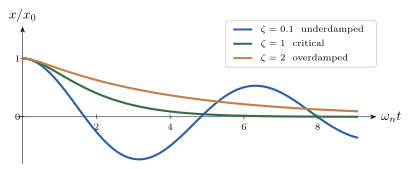
Pull a mass on a spring and let go: it swings at its own natural frequency while damping drains the energy away. That frequency is the number every later chapter compares against.
Chapter 2: SDOF Forced Vibration
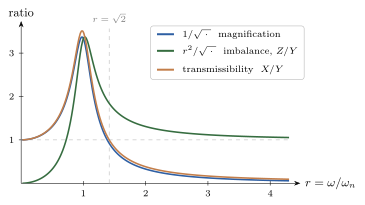
A machine that is pushed keeps moving for as long as the push lasts. Fans, pumps and washing machines shake themselves; cars and instruments are shaken by the ground under them. Every answer in this chapter depends on two numbers only: the frequency ratio r=ω/ωn and the damping ratio ζ.
Chapter 3: Two-Degree-of-Freedom Coupled Vibration
Two masses on springs, or one body free to bounce and pitch, have two natural frequencies and two mode shapes. Car suspensions, two-storey frames and vibration absorbers all work this way.

Chapter 4: Frequency Response and Analysis Techniques
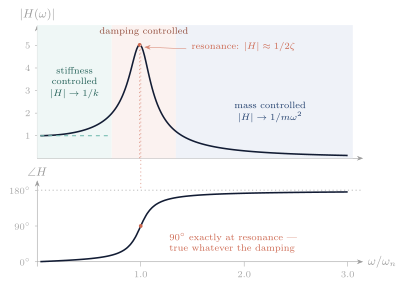
A machine reports its condition in its vibration. This chapter turns a record into a spectrum and a peak into a diagnosis: imbalance, misalignment, a worn gear or a failing bearing.
Chapter 5: Fundamental Frequency Estimation Methods
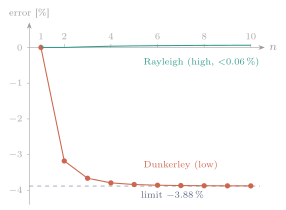
A shaft carrying several discs has as many natural frequencies as masses, and the lowest one sets the critical speed. Two quick methods bracket it without solving the full problem: Dunkerley from below, Rayleigh from above.