Chapter 4 cheat sheet
Chapter 4 cheat sheet: FRF, spectra and diagnosis
A machine reports its condition in its vibration. This chapter turns a record into a spectrum and a peak into a diagnosis: imbalance, misalignment, a worn gear or a failing bearing.
Start here
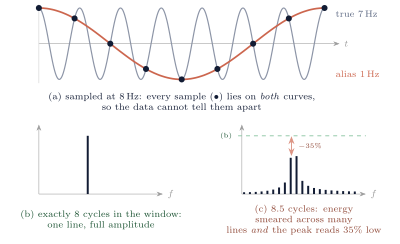
Check the measurement before reading any peak. The record length sets the resolution, the sampling rate sets the highest frequency you can trust (F4.2.1, F4.2.2), and a whole number of cycles in the record avoids leakage.
One picture
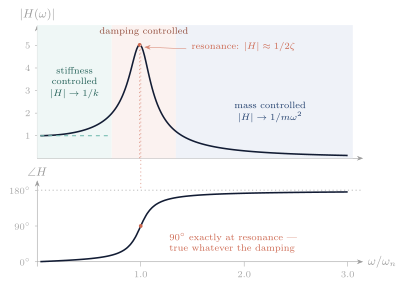
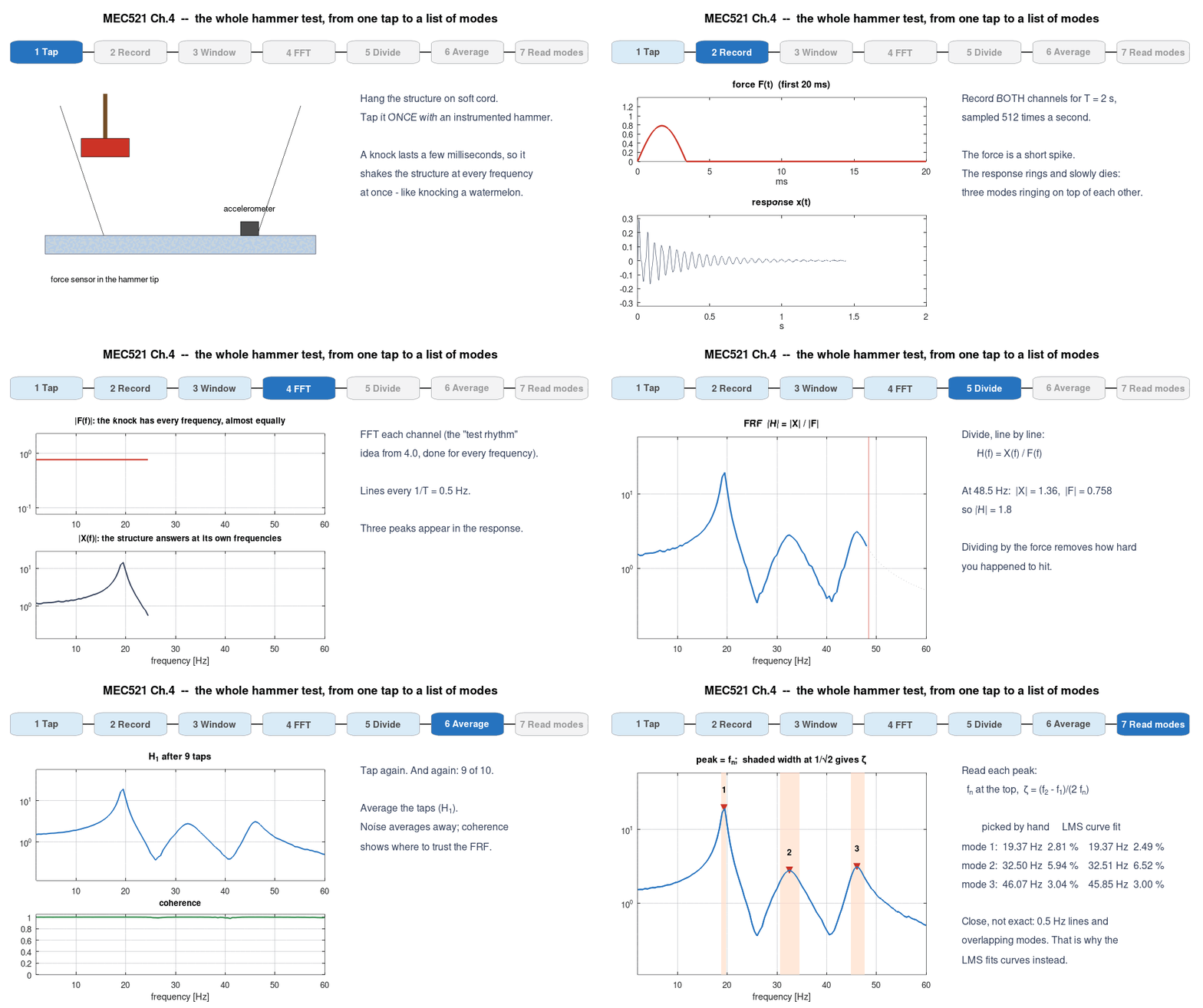
The FRF is Chapter 2's amplitude and phase as one complex number (F4.1.1): stiffness sets the response below resonance, mass above it, damping only near ωn. The animation runs a whole modal test.
Which formula?
Read the situation first, then pick the formula. The tags are the ones on the examination formula sheet and in Appendix A.
What do these analyser settings give me?
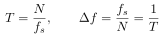 F4.2.1
Resolution is set by record length alone. Sampling faster buys bandwidth, not resolution.
 F4.2.2
Nothing above this can be measured. An anti-alias filter must remove it before sampling.
A peak with no physical explanation
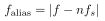 F4.2.3
Diagnosing a peak with no physical explanation. The test: change fs — a real peak stays put, an alias moves.
Gears
 F4.4.1
Gears. The same number from either shaft — computing it both ways is a free check.
A rolling-element bearing
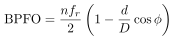 F4.4.3
Outer-race defect. Characteristically no sidebands at fr, because the defect sits still in the load zone.
 F4.4.6
Two free arithmetic checks that hold for every bearing. If either fails you have mistyped d/D.
Acceleration reading, velocity limit
 F4.3.1
Only when the signal is dominated by a single frequency. For a broadband signal, integrate in the frequency domain line by line.
Is this level acceptable?
 F4.5.2
Zone A new, B acceptable for continuous running, C unsatisfactory for continuous running, D damage occurring.
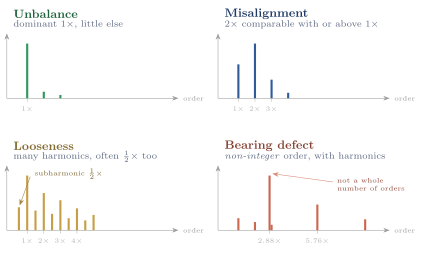
Reading the pictures
Ways to lose marks
- Faster sampling is not finer resolution. The line spacing is 1/T, set by the record length alone (F4.2.1). Sampling faster buys bandwidth, not detail.
- A peak that should not be there. Change the sampling rate: a real peak stays put, an alias moves (F4.2.3).
- Unwindowed amplitudes. A tone that falls between two lines leaks and reads low. Never trust an amplitude read without a window.
- Acceleration is not velocity. vrms=arms/2π f holds only when one frequency dominates (F4.3.1). The severity zones are in velocity (F4.5.2).
- Bearing arithmetic. Two checks hold for every bearing; if either fails, d/D is mistyped (F4.4.6).
Handbook: § 4.1–§ 4.7 for the worked examples, Appendix A for every tag. Slides: the Chapter 4 deck, with every animation. Download the one-page PDF to print.