CoursesMEC521 Vibrations

Chapter

Chapter 1: SDOF Free Vibration

Weeks 1–4. Covers AIMS syllabus topics 1.0 and 2.0

What is covered

Week 1 28 Sept to 4 Oct 2026

  • Historical background
  • Basic concepts and classification of vibration
  • Analytical preliminaries
  • Harmonic motion

Week 2 5 Oct to 11 Oct 2026

  • Modelling
  • Equivalent stiffness and mass
  • Equation of motion
  • Undamped free vibration
  • Natural frequency and static deflection

Week 3 12 Oct to 18 Oct 2026

  • Damped free vibration
  • Underdamped, critically damped and overdamped response
  • Logarithmic decrement

Week 4 19 Oct to 25 Oct 2026

  • Determination of damping characteristics from measured decay
  • Introduction to harmonic excitation

Cheat sheet
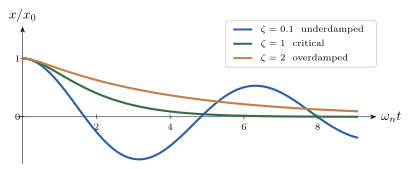
The same system released from the same place at three damping ratios. Below ζ=1 it oscillates inside a shrinking envelope; at ζ=1 it returns fastest without overshoot; above 1 it creeps back more slowly, not more safely.One page for Chapter 1The key picture, which formula to use when, and the ways to lose marksOpen the Chapter 1 cheat sheet

Animations

Show the 9 animations from the lecture slides
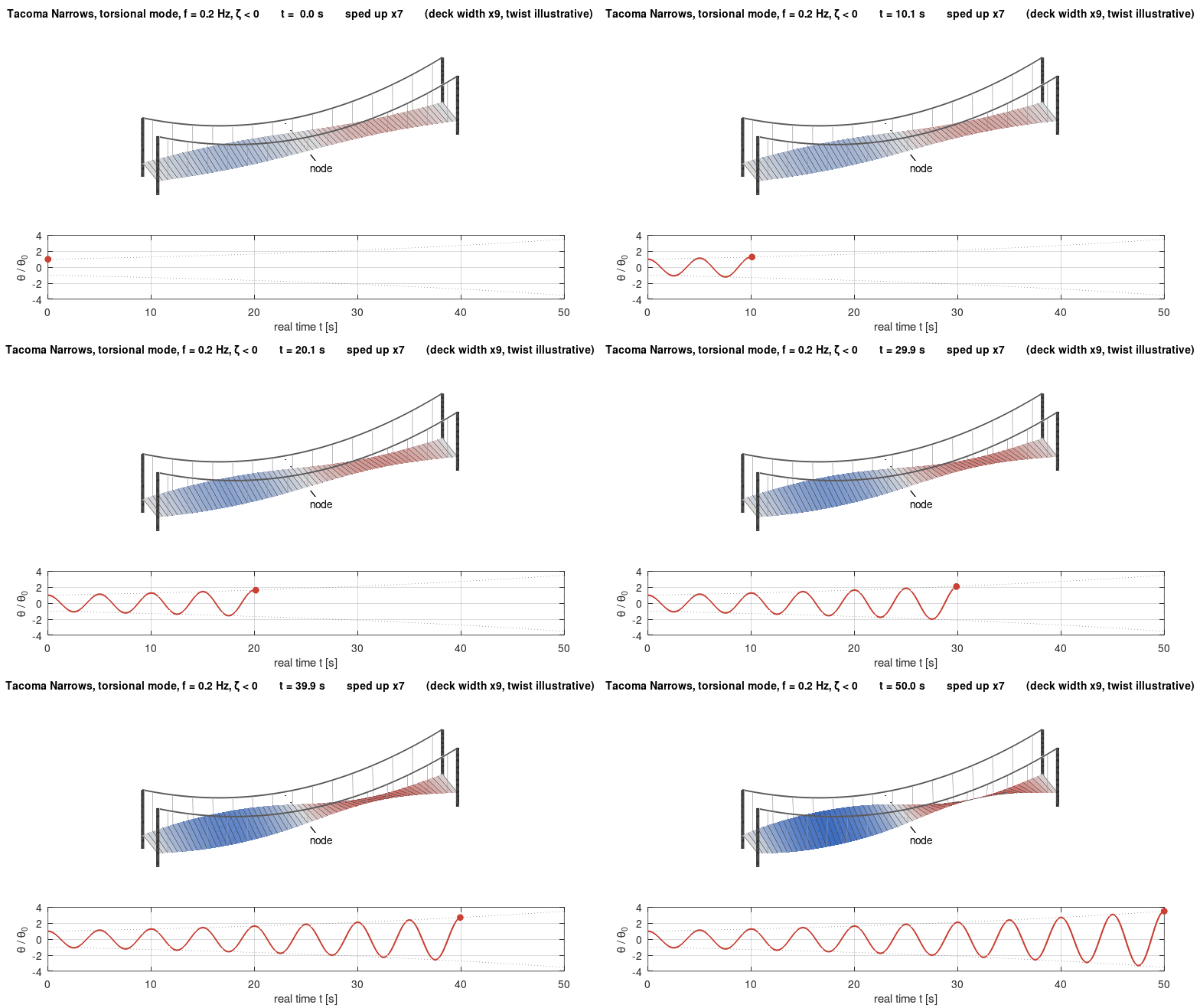
The torsional mode, reconstructed: the main span twisting in one torsional mode at 0.2 Hz, one half up and one half down with the centre line still; the twist grows because ζ < 0 (width and twist exaggerated)
The torsional mode, reconstructed. The main span twisting in one torsional mode at 0.2 Hz, one half up and one half down with the centre line still; the twist grows because ζ < 0 (width and twist exaggerated).
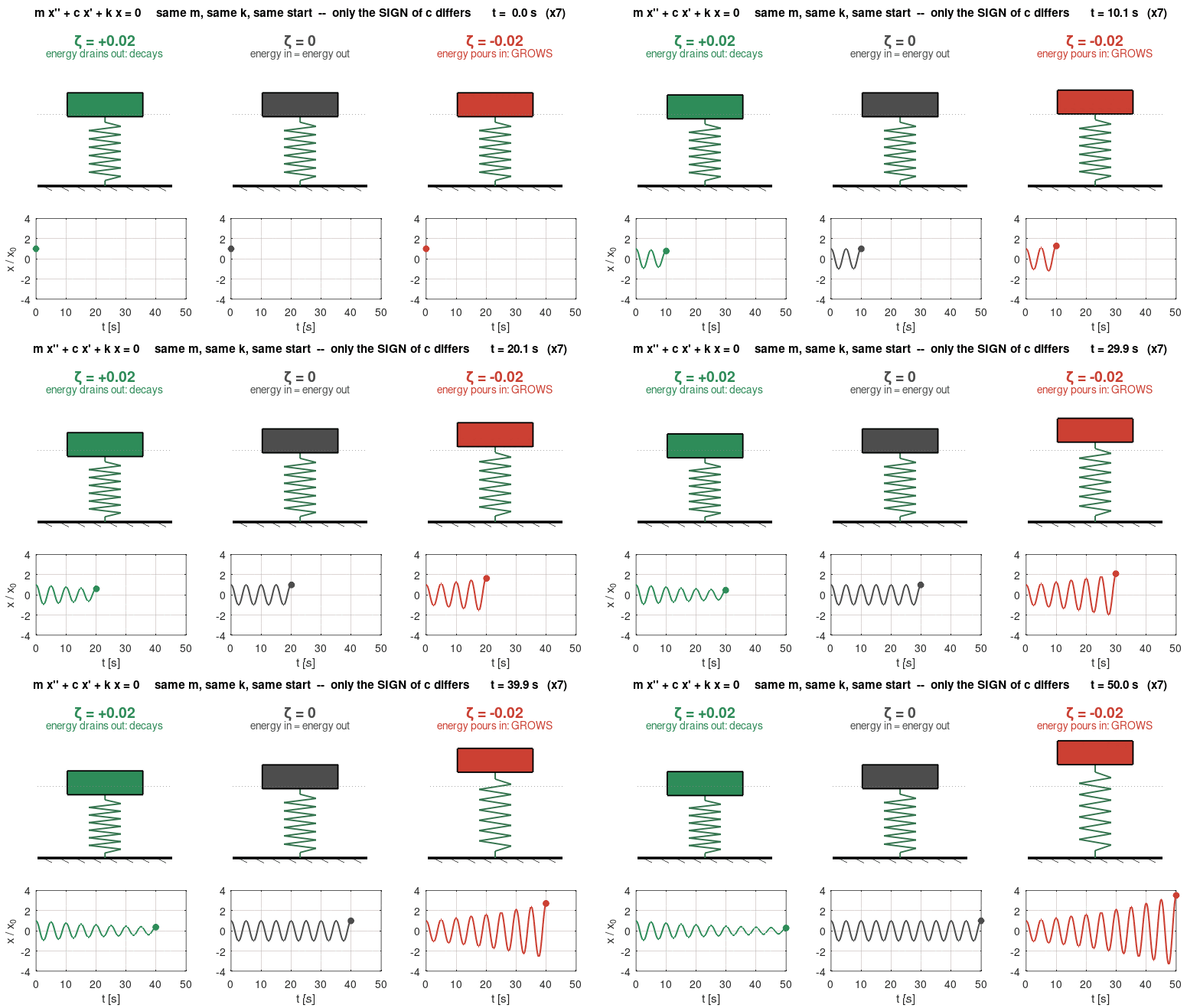
The whole story in one sign: three identical oscillators at ζ = +0.02, 0 and −0.02, same start: after 10 cycles 0.28 of the start, unchanged, and 3.5 times the start (ζ = ±0.02 is illustrative, not measured)
The whole story in one sign. Three identical oscillators at ζ = +0.02, 0 and −0.02, same start: after 10 cycles 0.28 of the start, unchanged, and 3.5 times the start (ζ = ±0.02 is illustrative, not measured).
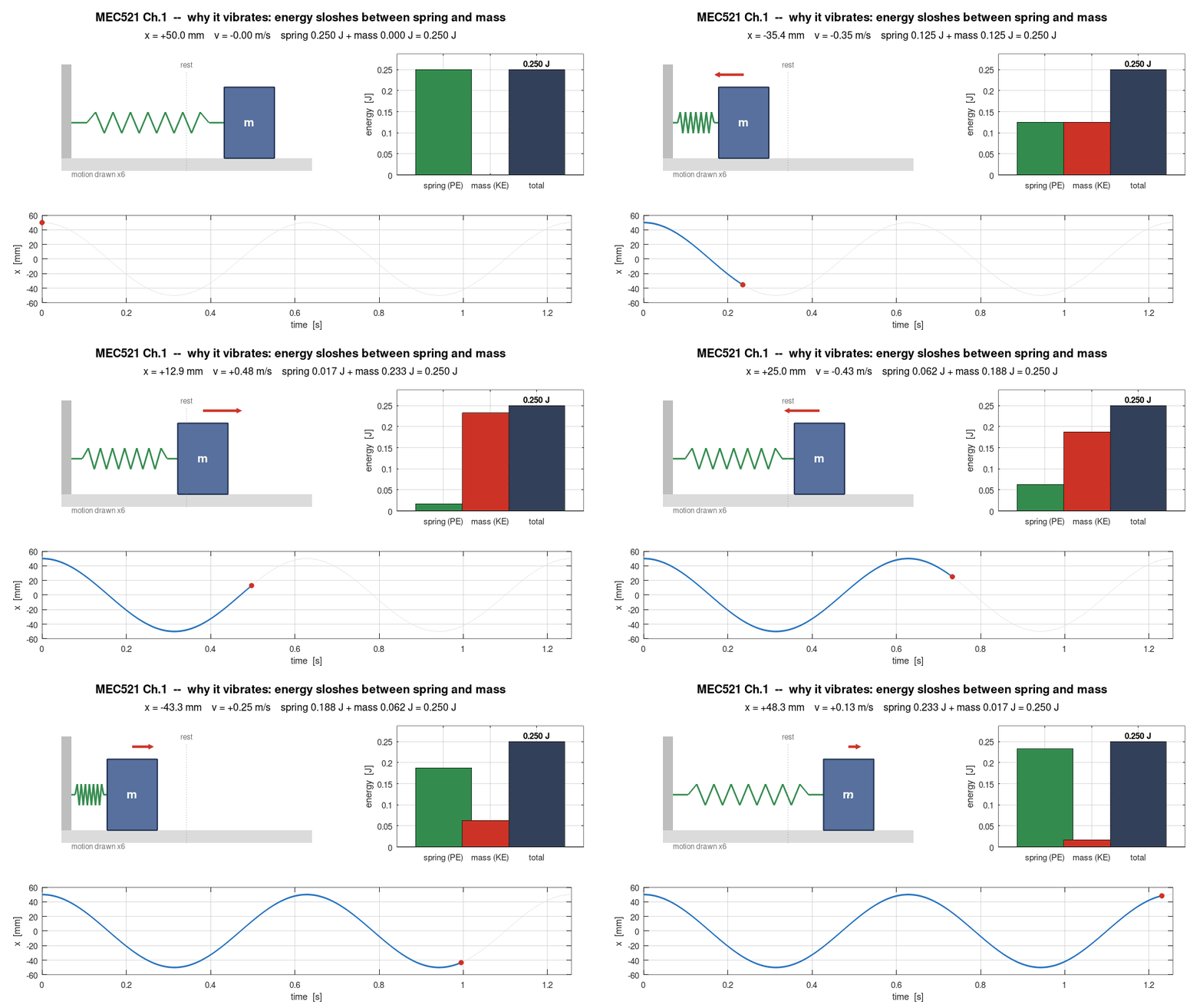
Watch the energy slosh: 2 kg on 200 N/m from 50 mm: KE/PE bars swap, total fixed at 0.250 J; two exact periods so it loops seamlessly
Watch the energy slosh. 2 kg on 200 N/m from 50 mm: KE/PE bars swap, total fixed at 0.250 J; two exact periods so it loops seamlessly.
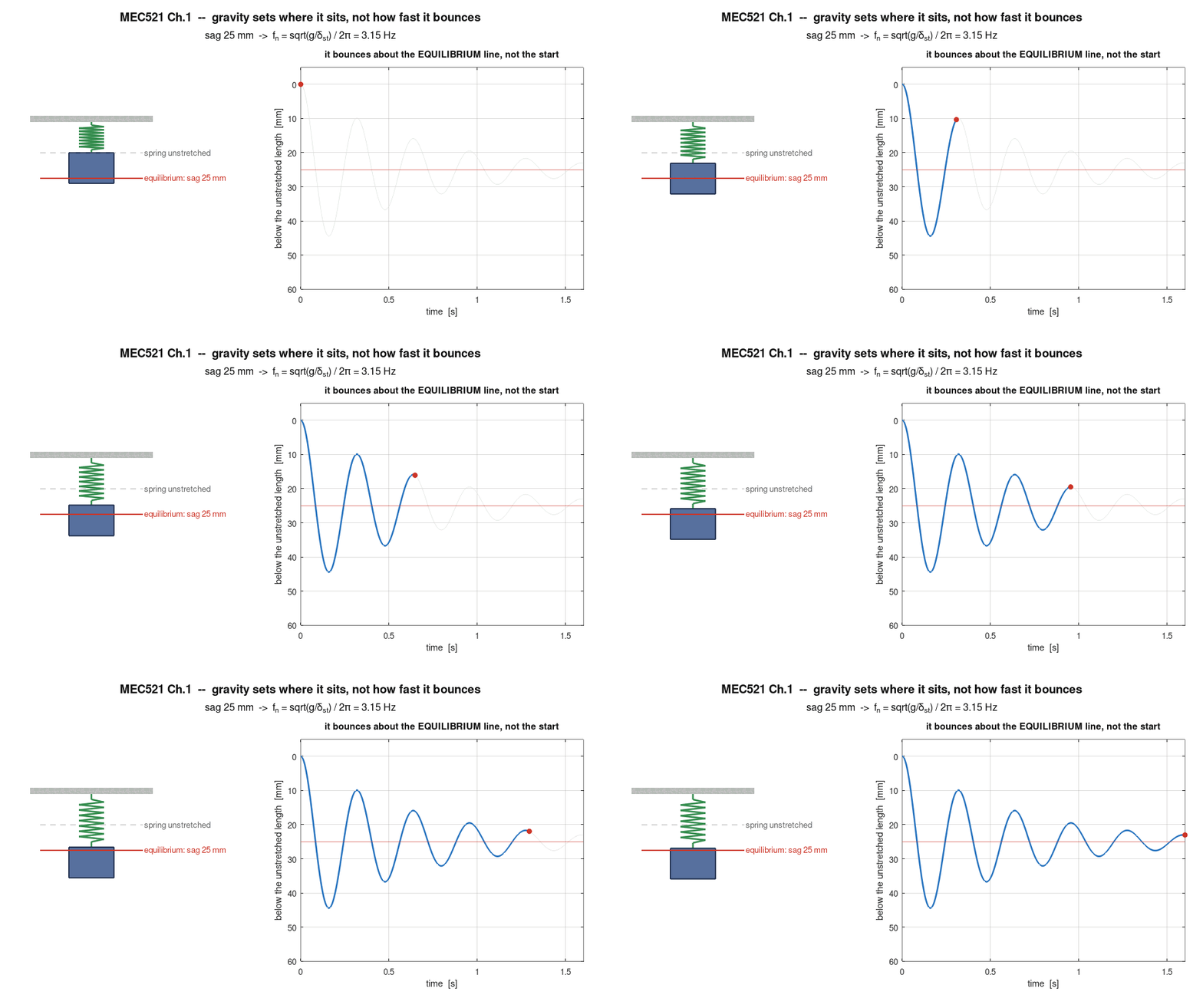
Watch gravity set the stage…: hung on an unstretched spring and released: bounces about the 25 mm equilibrium line at 3.15 Hz
Watch gravity set the stage…. Hung on an unstretched spring and released: bounces about the 25 mm equilibrium line at 3.15 Hz.
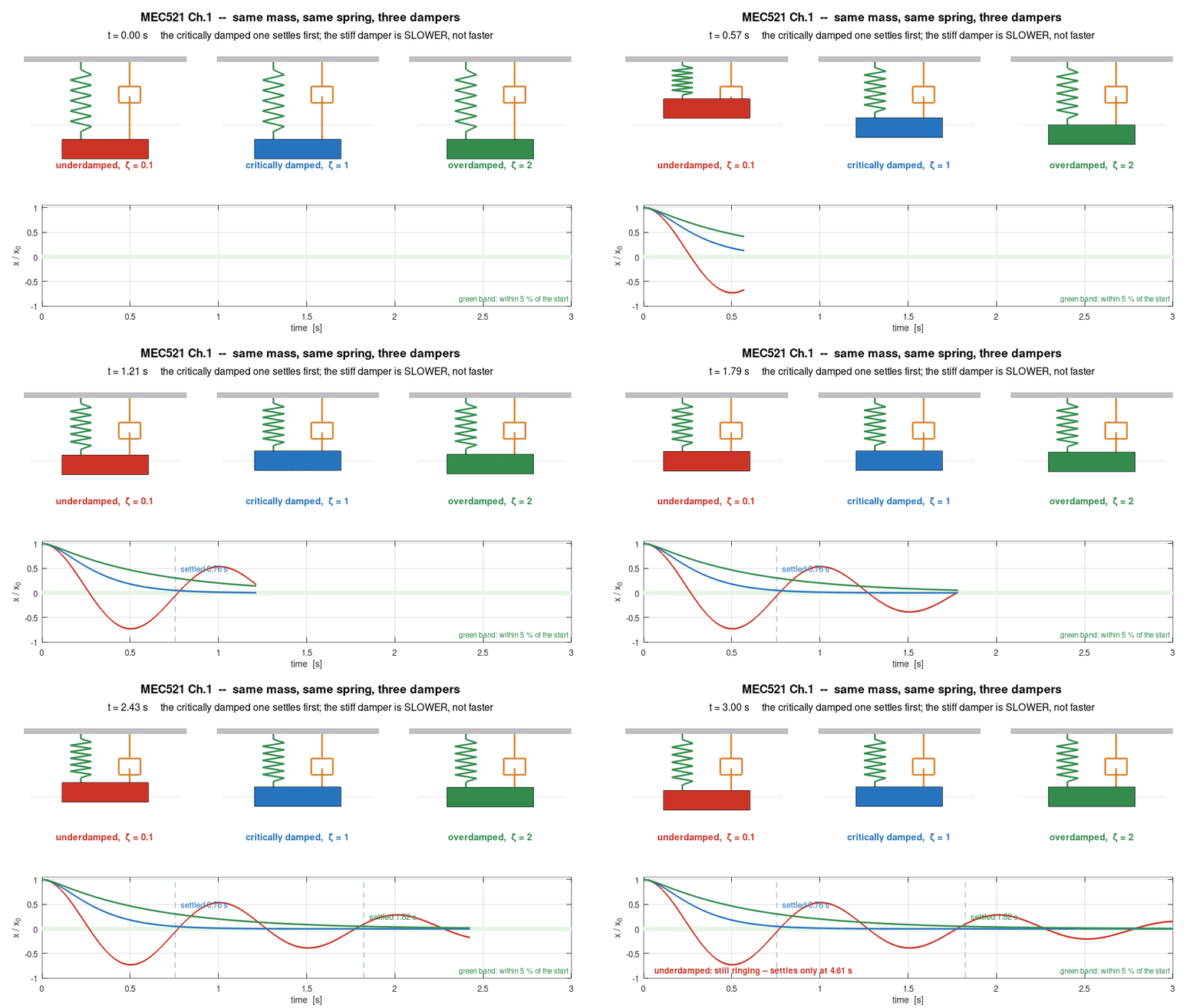
Watch three dampers race: ζ = 0.1, 1, 2 at f_n = 1 Hz; settle within 5 %: 4.61, 0.76, 1.82 s
Watch three dampers race. Ζ = 0.1, 1, 2 at fn = 1 Hz; settle within 5 %: 4.61, 0.76, 1.82 s.
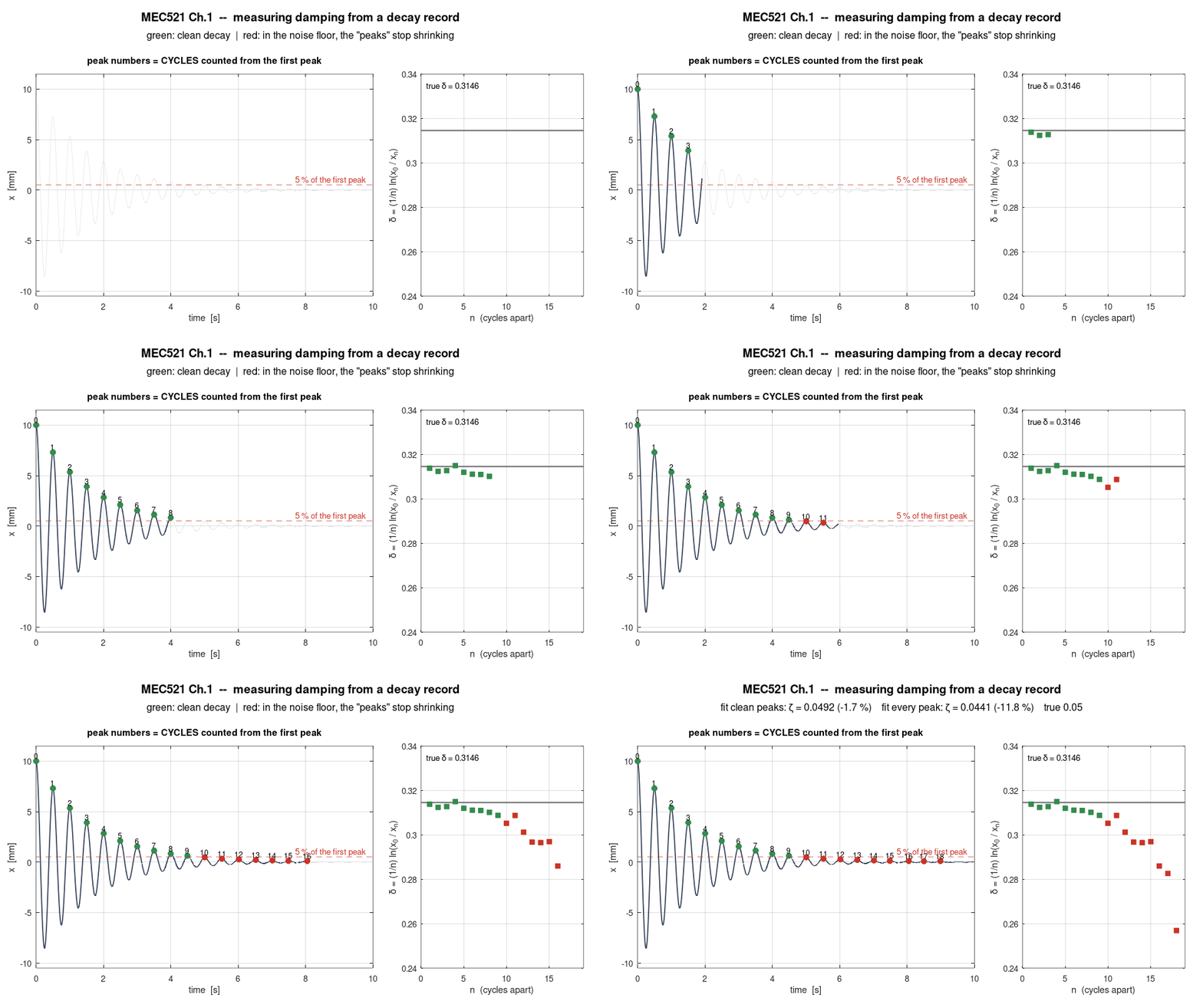
Watch the decrement being measured: 2 Hz ring-down, ζ = 0.05, 0.02 mm noise: peaks numbered by cycle; δ per n; clean fit −1.7 % vs all-peaks −11.8 %
Watch the decrement being measured. 2 Hz ring-down, ζ = 0.05, 0.02 mm noise: peaks numbered by cycle; δ per n; clean fit −1.7 % vs all-peaks −11.8 %.
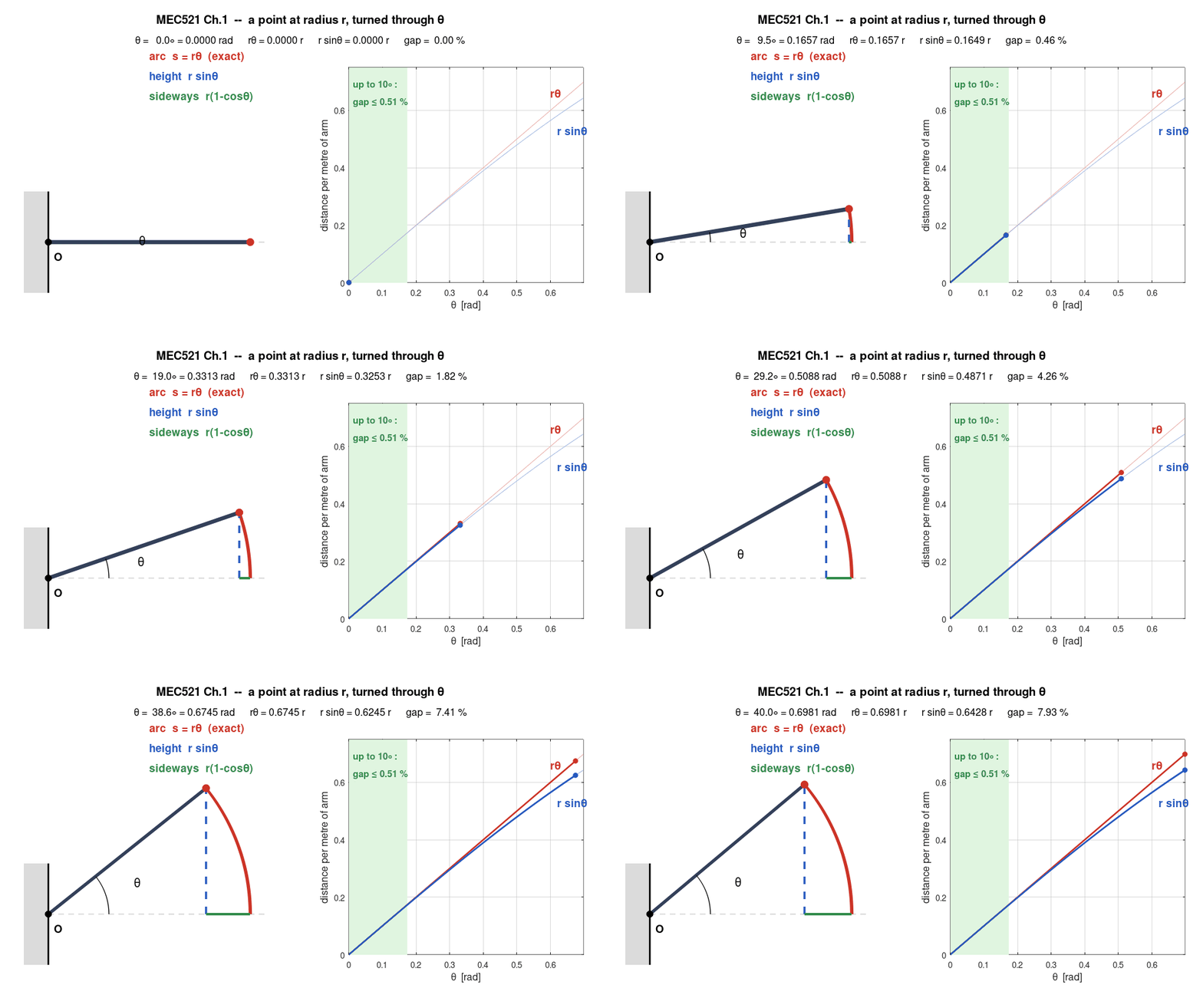
Watch the arc and the height part company: arc rθ vs height r sinθ vs sideways r(1−cosθ), swept 0–40°, with the gap plotted (0.51 % at 10°)
Watch the arc and the height part company. Arc rθ vs height r sinθ vs sideways r(1−cosθ), swept 0–40°, with the gap plotted (0.51 % at 10°).
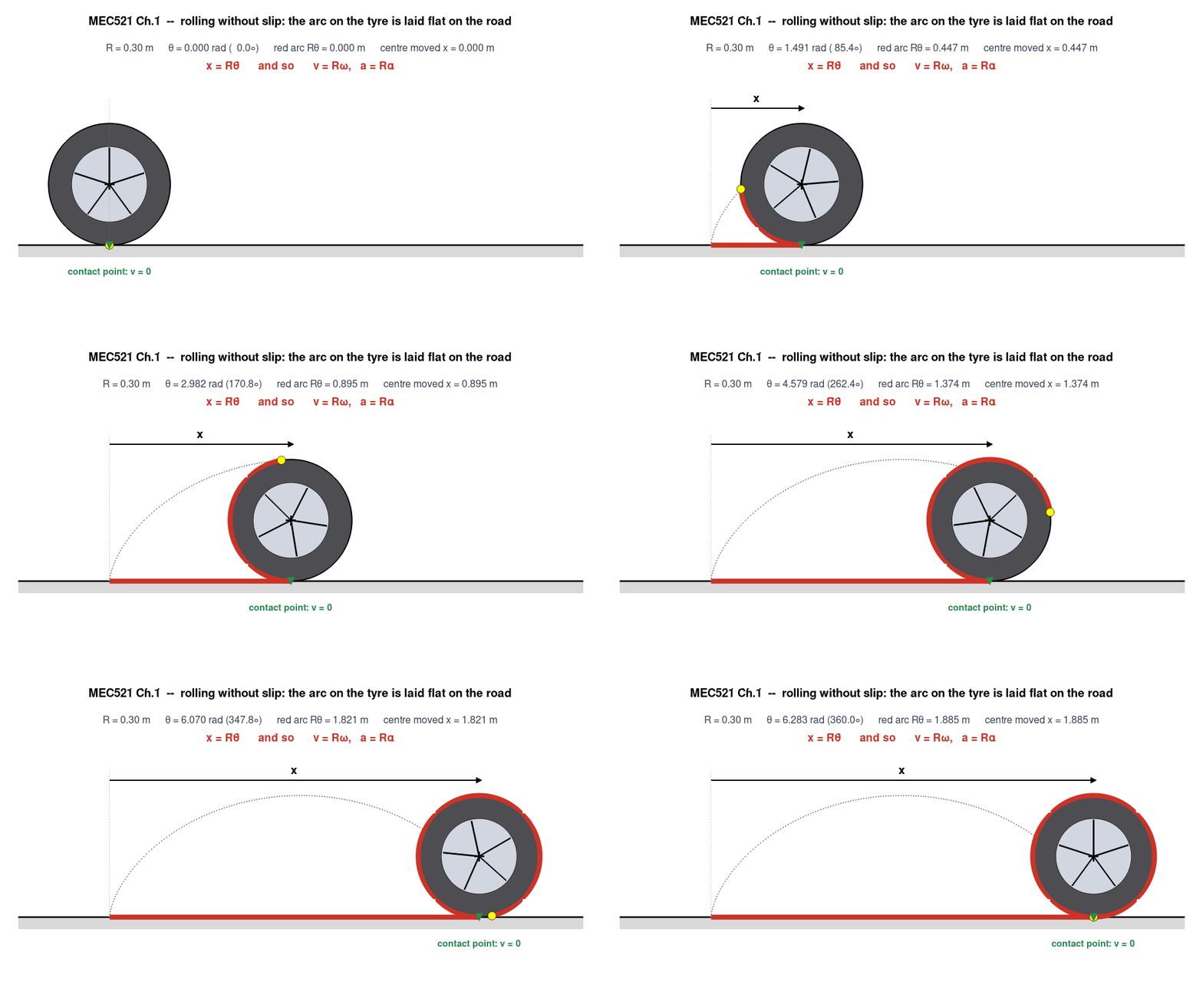
Watch the rim being laid on the road: 0.30 m tyre rolling one turn; red rim arc = red road length; paint mark traces a cycloid and stops at the contact
Watch the rim being laid on the road. 0.30 m tyre rolling one turn; red rim arc = red road length; paint mark traces a cycloid and stops at the contact.
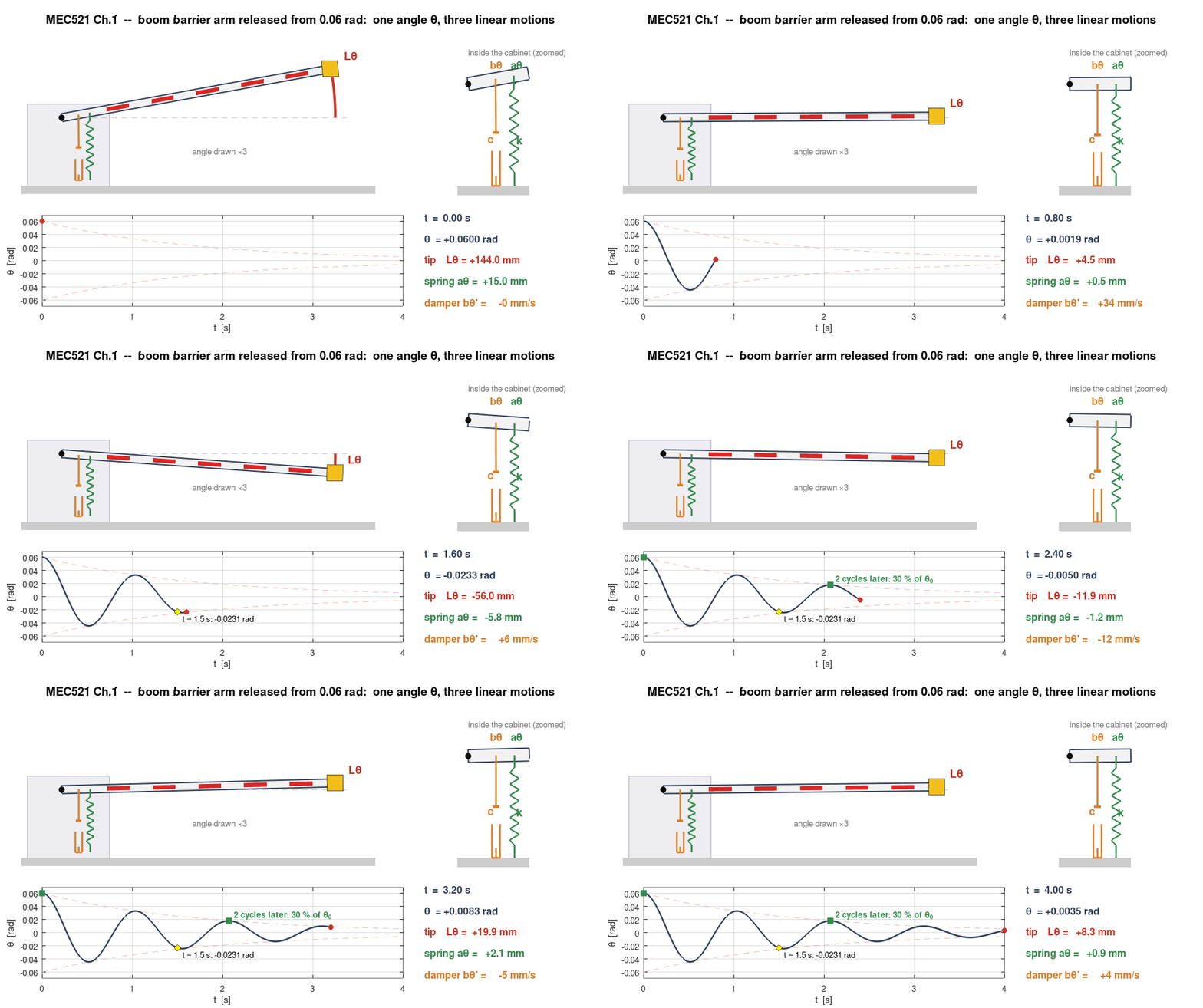
The boom barrier, running: the worked example released from 0.06 rad: tip Lθ, spring aθ, damper bθ̇ read out live; decay trace with the 30 %-after-2-cycles peak and θ(1.5 s)
The boom barrier, running. The worked example released from 0.06 rad: tip Lθ, spring aθ, damper bθ̇ read out live; decay trace with the 30 %-after-2-cycles peak and θ(1.5 s).

Download