Chapter 1 cheat sheet
Chapter 1 cheat sheet: Free vibration of an SDOF system
Pull a mass on a spring and let go: it swings at its own natural frequency while damping drains the energy away. That frequency is the number every later chapter compares against.
Start here
Model first: one mass m, one equivalent stiffness k, one damper c, with displacement measured from static equilibrium so the weight drops out. Then ωn=√(k/m) (F1.3.2) and ζ=c/cc with cc=2√km (F1.4.2, F1.4.3).
One picture
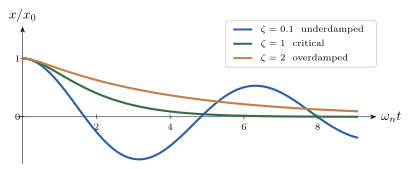
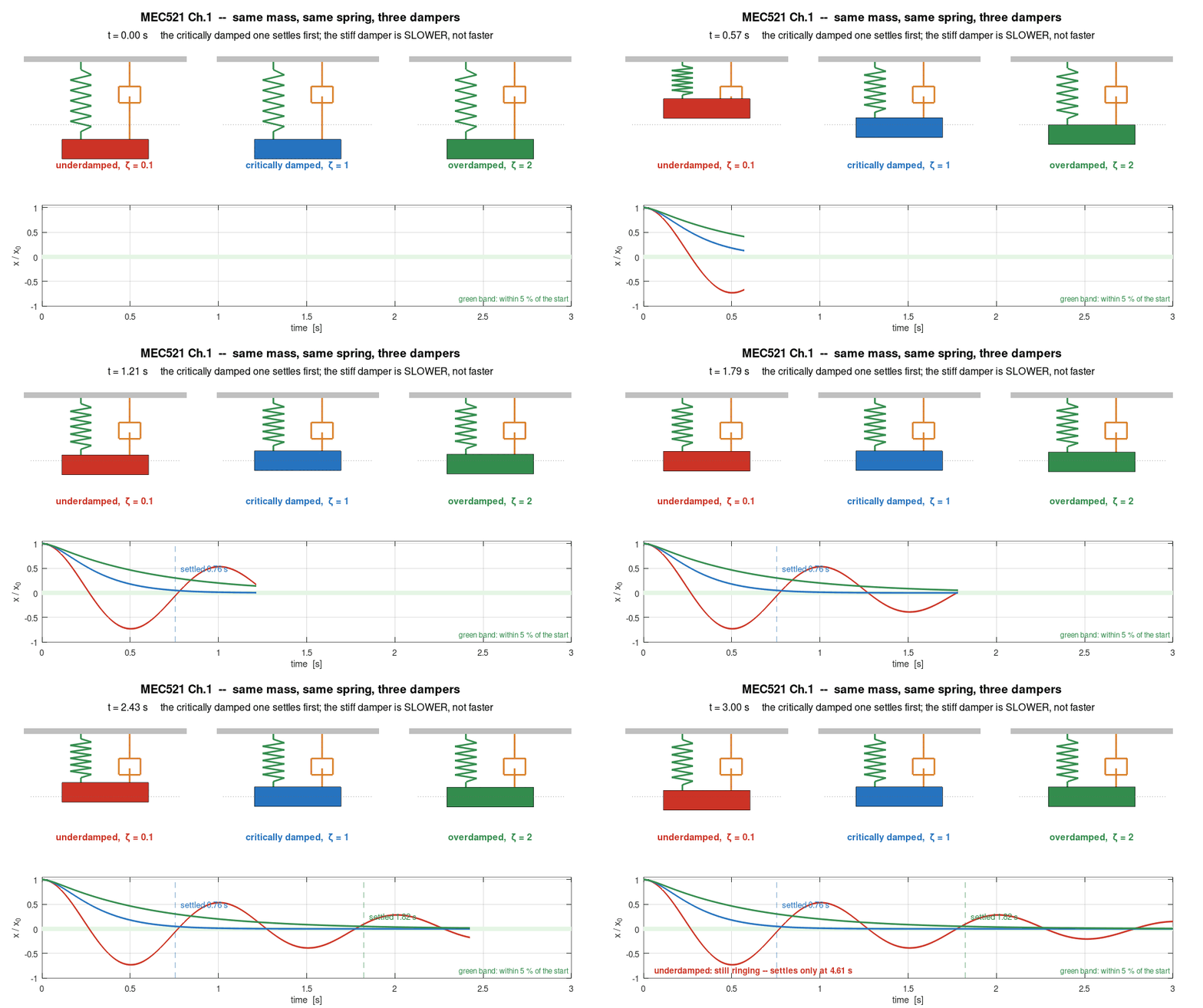
The same system released from the same place at three damping ratios. Below ζ=1 it oscillates inside a shrinking envelope; at ζ=1 it returns fastest without overshoot; above 1 it creeps back more slowly, not more safely.
Which formula?
Read the situation first, then pick the formula. The tags are the ones on the examination formula sheet and in Appendix A.
Two or more springs carrying one mass
 F1.2.1
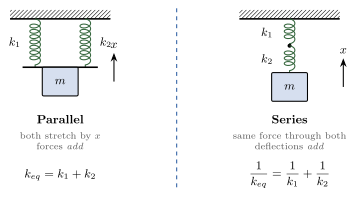
Springs in parallel — they share the deflection, not the load. Physical layout is irrelevant.
 F1.2.2
Springs in series. The softest element dominates.
The mass sits on a beam, arm or shaft
 F1.2.3
Mass at the free end of a cantilever; beam mass negligible.
How fast does it oscillate?
 F1.3.2
The single most-used result in the course.
A measured decay trace — how much damping?
 F1.5.1
Viscous damping only — see F1.5.4. Use n≥3 where the trace allows.
 F1.5.2
Always valid for viscous damping. Use this form, not the approximation, unless asked.
How long before it stops moving?
 F1.4.7
Settling time. Note it depends on the product ζωn, so stiffening and damping are both routes to a faster settle.
The decay is straight, not curved
 F1.5.4
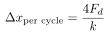
Coulomb (dry friction) damping. Its decay is linear, not exponential: constant differences, not constant ratios. If the ratios are not constant, F1.5.1 does not apply.
Reading the pictures
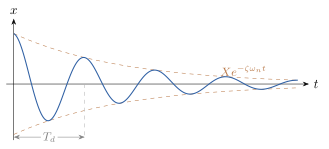
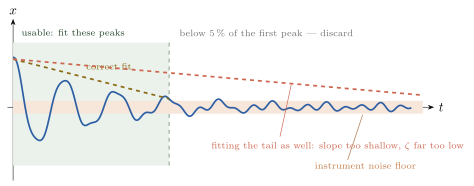
Ways to lose marks
- rad/s is not Hz. ωn is in rad/s. The frequency in Hz is fn=ωn/2π and the period is T=1/fn. Mixing them is the commonest unit error.
- Weight left in the equation. Measured from static equilibrium, the weight cancels the spring's pre-stretch. If mg is still in your equation of motion, the coordinate is wrong.
- More damping is not safer. Above ζ=1 the system creeps back more slowly. Critical damping is the fastest return without overshoot.
- A straight decay. If the peaks fall by equal differences, not equal ratios, the damping is dry friction (F1.5.4) and the logarithmic decrement does not apply.
Handbook: § 1.1–§ 1.5 for the worked examples, Appendix A for every tag. Slides: the Chapter 1 deck, with every animation. Download the one-page PDF to print.