Chapter 2 cheat sheet
Chapter 2 cheat sheet: Forced vibration of an SDOF system
A machine that is pushed keeps moving for as long as the push lasts. Fans, pumps and washing machines shake themselves; cars and instruments are shaken by the ground under them. Every answer in this chapter depends on two numbers only: the frequency ratio r=ω/ωn and the damping ratio ζ.
Start here
Find r first, always. Convert the speed to ω in rad/s (ω=2π N/60 for N rev/min) and work out ωn=√(k/m), then say what r means before any arithmetic: below 1, near 1, or past √2.
One picture
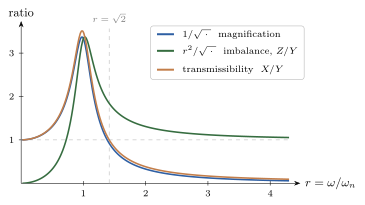
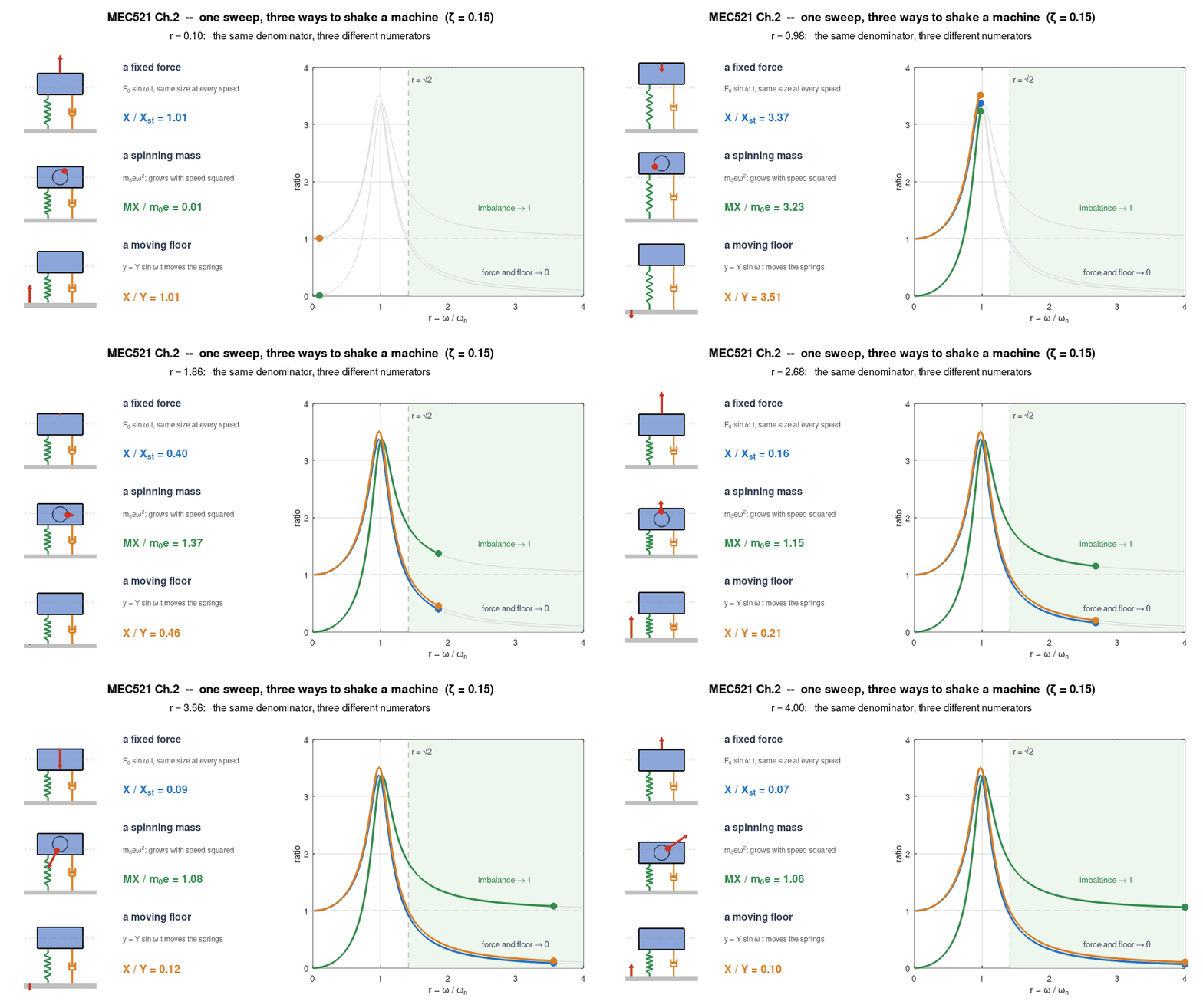
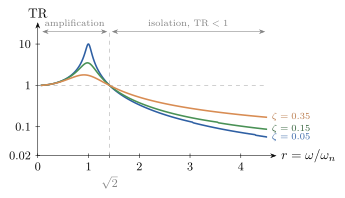
One picture holds the chapter. The three ratios share one denominator; the numerator tells you which machine you have. Only the moving-floor curve crosses 1 exactly at r=√2.
Which formula?
Read the situation first, then pick the formula. The tags are the ones on the examination formula sheet and in Appendix A.
A constant-amplitude force shakes the machine
 F2.2.2
Constant-amplitude force. Not rotating imbalance — use F2.3.1.
The machine's own rotation shakes it
 F2.3.1
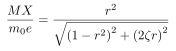
Any machine whose excitation comes from its own rotation: fans, pumps, spin dryers. Using F2.2.2 here is the commonest error in Chapter 2.
The floor or base is what moves
 F2.4.2
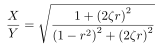
Displacement transmissibility. Identical in form to the force transmissibility F2.5.1 — one curve answers both questions.
A vehicle crossing a wavy surface
 F2.4.4
Converting road or track geometry into an excitation frequency. Resonance occurs at v=fnλ.
How much force reaches the foundation?
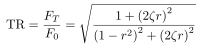 F2.5.1
Force transmissibility. Same function as F2.4.2.
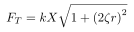 F2.5.2
A second, independent route to FT once X is known — use it to cross-check F2.5.1.
Will this mount isolate at all?
 F2.5.3
Isolation is only possible for r>√2. Below it the mount amplifies, whatever damper you fit.
Reading the curves
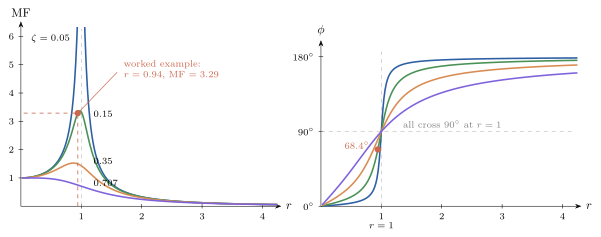
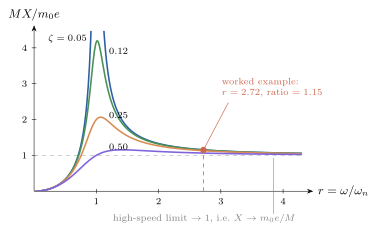
Ways to lose marks
- The wrong numerator. Three formulas share one denominator. Name the ratio before you use it: a constant force is F2.2.2, a spinning mass F2.3.1, a moving floor F2.4.2.
- The phase above resonance. For r>1 the calculator's tan−1 gives a negative angle. The lag is in the second quadrant: add 180° (F2.2.3).
- √2 is a minimum. Isolation needs r>√2, so the mount stiffness is a maximum. A softer mount isolates; a stiffer one fails the specification (F2.5.3).
- Damping past √2. Above r=√2 more damping lets more through. Damping is for getting through resonance on the run-up, not for isolation (F2.5.1).
- rev/min is not rad/s. N rev/min gives ω=2π N/60. Using N or f as ω puts r out by a factor of 2π or more.
Handbook: § 2.1–§ 2.5 for the worked examples, Appendix A for every tag. Slides: the Chapter 2 deck, with every animation. Download the one-page PDF to print.