Chapter 3 cheat sheet
Chapter 3 cheat sheet: Two-degree-of-freedom systems
Two masses on springs, or one body free to bounce and pitch, have two natural frequencies and two mode shapes. Car suspensions, two-storey frames and vibration absorbers all work this way.
Start here
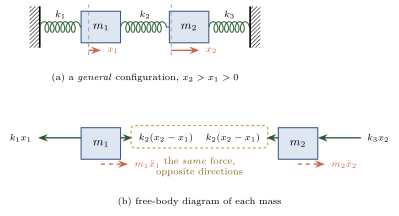
Draw both free-body diagrams, write the equations in matrix form (F3.2.1) and check [k] is symmetric (F3.2.2). Then solve the frequency equation (F3.3.1) and take each mode shape from either row (F3.3.2).
One picture
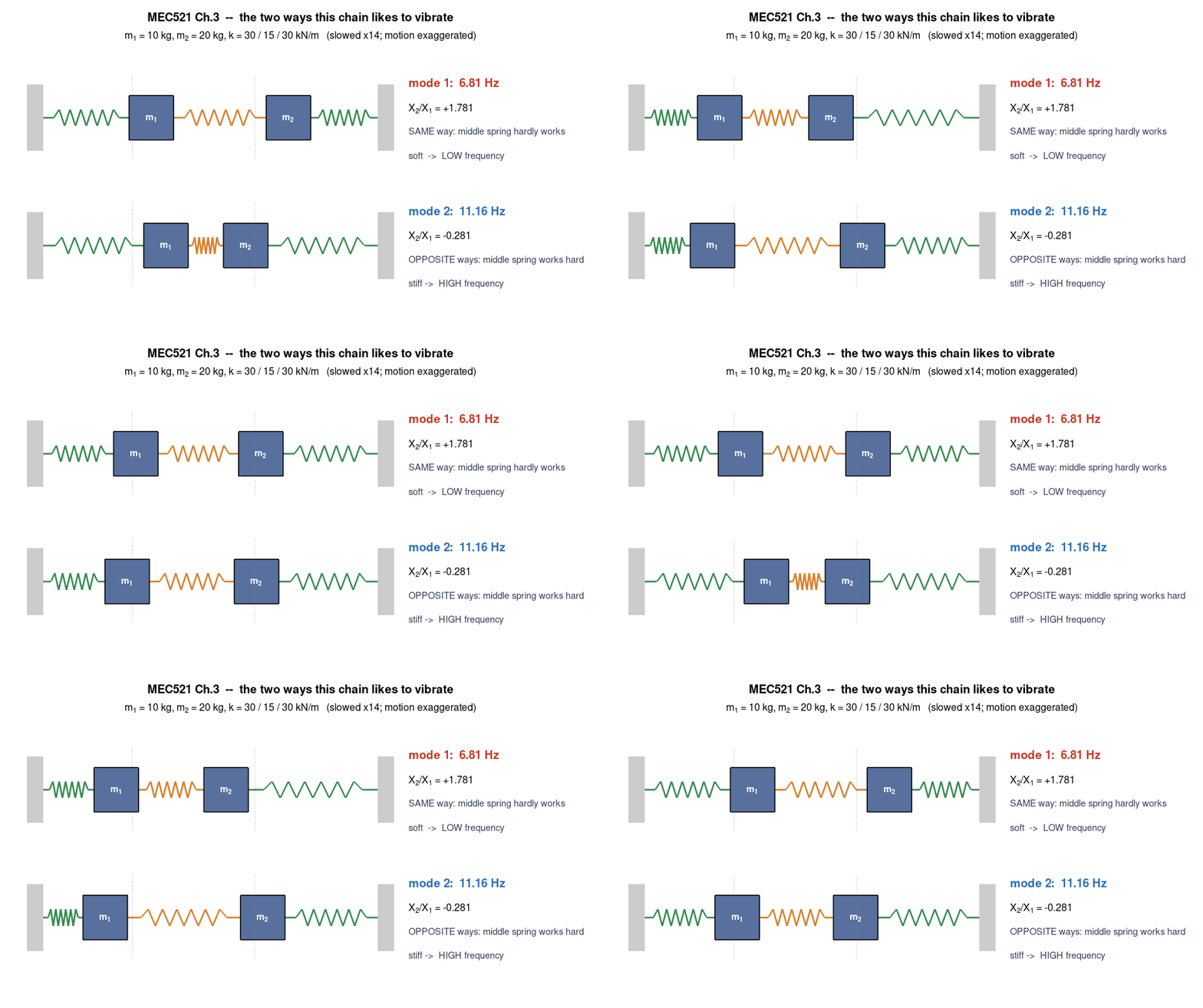
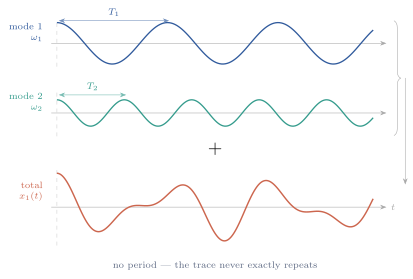
A mode is a pattern, not an amplitude. In each mode both masses move at one frequency in a fixed ratio X2/X1: together in the first mode, against each other in the second.

Which formula?
Read the situation first, then pick the formula. The tags are the ones on the examination formula sheet and in Appendix A.
Two masses — write the equations
 F3.2.1
Any linear multi-degree-of-freedom system.
…{} and check them before going on
 F3.2.2
A free check on every assembled matrix. An asymmetric [k] is always an error in the coupling term's sign.
 F3.2.3
Row sums: zero for a mass with no path to ground, hence zero for a free end. A non-zero row sum where none is expected means a mis-assembled row.
Find the natural frequencies
 F3.3.1
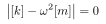
The frequency (characteristic) equation. Its roots are ωi2.
Find the mode shapes
 F3.3.2
Mode shape. Both rows must give the same ratio — that agreement is your check that ωi is right.
Nothing anchors it to ground
 F3.3.4
Free–free systems: two rotors on a coupling, a shaft on soft bearings. The zero root is correct physics, not an arithmetic failure.
Kill the vibration at one known speed
 F3.5.1
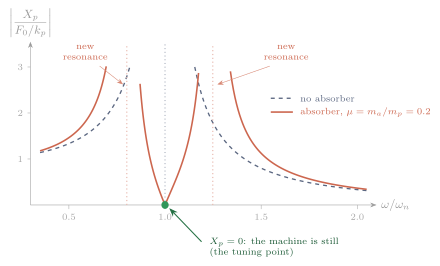
The tuning condition. Tune the absorber's own natural frequency to the excitation and the primary mass stops dead.
 F3.5.2
Absorber stroke. Sizing the device, and the reason undamped absorbers are large.
Reading the pictures
Ways to lose marks
- The coupling sign. The coupling force acts on both masses with opposite signs. An asymmetric [k] always means that sign is wrong (F3.2.2).
- ω2, not ω. The roots of the frequency equation are ω12 and ω22. Take the square root before converting to Hz.
- Check the mode shape. Both rows must give the same X2/X1 (F3.3.2). If they disagree, the frequency is wrong.
- An absorber needs a fixed speed. It works at one frequency only; near its two new resonances it makes things worse (F3.5.3).
Handbook: § 3.1–§ 3.5 for the worked examples, Appendix A for every tag. Slides: the Chapter 3 deck, with every animation. Download the one-page PDF to print.