Cheat sheets, all chapters
One page per chapter: the picture that holds the chapter, which formula to use when, and the ways to lose marks. Each one has its own page and prints on a single A4 sheet.
Chapter 1: Introduction to Control Systems and Mathematical Review
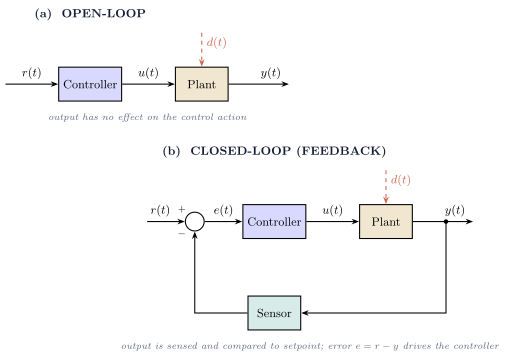
A control system measures what a machine is doing, compares it with what it should be doing, and corrects the difference. This chapter gives the language: the Laplace transform turns the machine's differential equations into algebra, and the transfer function holds the whole machine in one fraction.
Chapter 2: System Model Representation
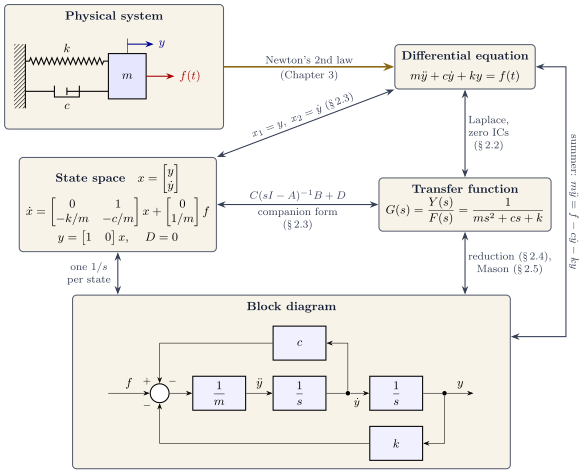
One machine can be written four ways: a differential equation, a transfer function, state space, and a block diagram or signal-flow graph. Each suits a different job, and moving between them without losing anything is the skill this chapter builds.
Chapter 3: Mathematical Modelling of Engineering Systems
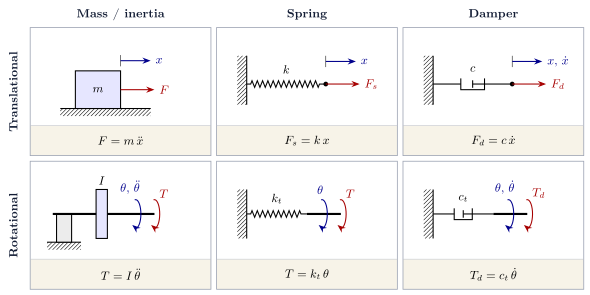
Before a machine can be controlled it must be described. This chapter builds the description from physics: Newton's laws for masses and shafts, Kirchhoff's laws for circuits, mass balance for tanks, and both at once for a motor. The result is always a transfer function.
Chapter 4: System Performance Analysis
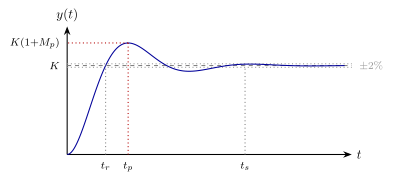
A model says how a machine moves; a specification says how it should. This chapter reads time constants, overshoot, settling time and steady error off a transfer function, decides with Routh whether a loop is stable, and shows how the poles move as the gain is turned up.
Chapter 5: Frequency Response Analysis
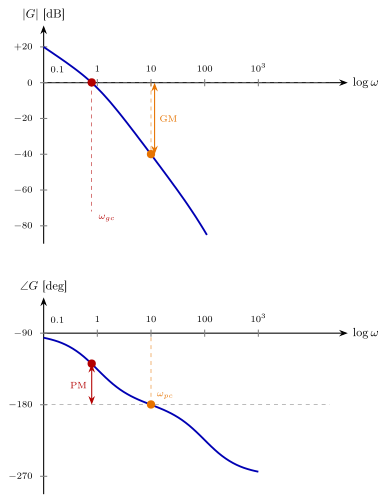
Drive a stable system with a sine wave and, once the transient dies, the output is a sine at the same frequency, scaled and delayed. Bode and Nyquist plots record that scaling and delay at every frequency, and from them come the gain and phase margins: how far a loop is from instability.