Chapter 2 cheat sheet
Chapter 2 cheat sheet: System model representation
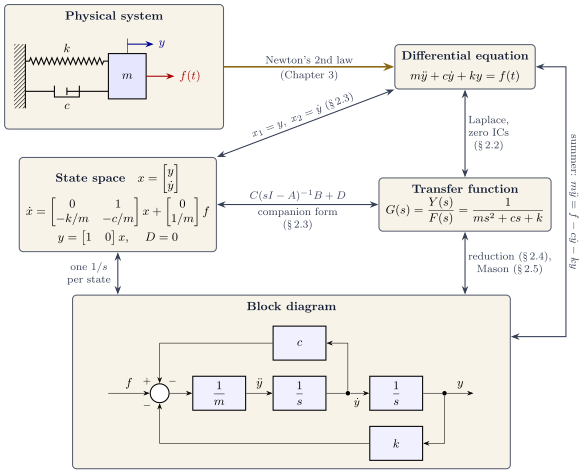
One machine can be written four ways: a differential equation, a transfer function, state space, and a block diagram or signal-flow graph. Each suits a different job, and moving between them without losing anything is the skill this chapter builds.
Start here
Linearise first if the physics is not linear. Then use the form the question asks for, and check at the end that the characteristic equation, the poles and the DC gain come out the same in every form.
One picture
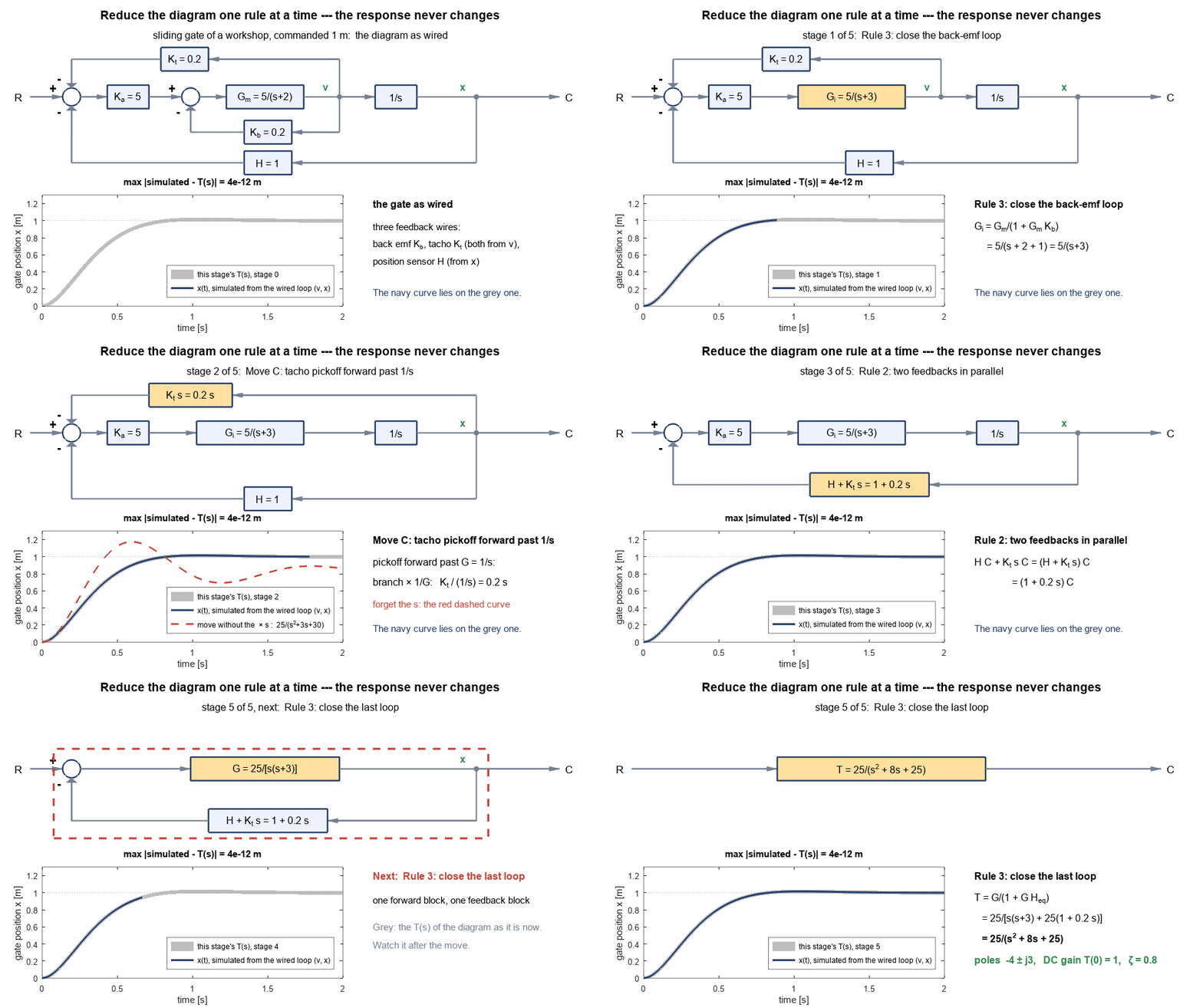
Four representations of one plant, each an exact translation of the others. The animation reduces a block diagram move by move and runs the response after every move: it never changes.
Which formula?
Read the situation first, then pick the formula. The numbers in brackets are the handbook's equation numbers.
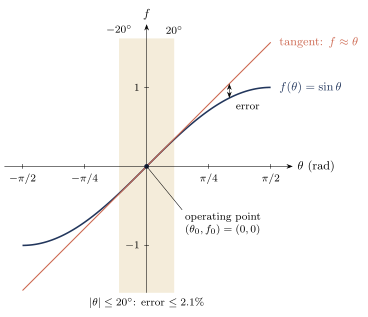
A nonlinear element
 (2.2)
Small deviations about the operating point only.
Input–output form
 (2.3)
Zero initial conditions; the denominator set to zero is the characteristic equation.
Where a step response settles
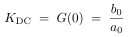 (2.5)
Only for a stable system: the final value of a unit-step response.
Internal variables, several inputs
 (2.7)
One first-order equation per state; the number of states is the order.
 (2.8)
D is zero unless the input reaches the output directly.
State space to a transfer function
 (2.9)
The poles of G(s) are the eigenvalues of A.
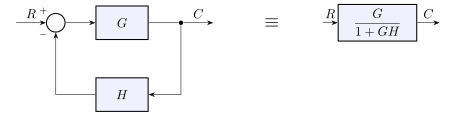
A feedback loop to reduce
 (2.11)
Plus in the denominator for negative feedback.
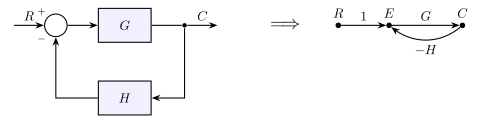
Many loops, no reduction
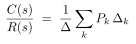 (2.12)
Δ subtracts every loop gain and adds the products of loops that do not touch.
Reading the pictures
Ways to lose marks
- Moving a summer or a pickoff. Moving it past a block needs a compensating block. Check by tracing one signal through, before and after.
- Non-touching loops. Only loops that share no node multiply in Δ.
- Too few states. An nth-order equation needs n states, so a second-order plant has a 2×2 A.
- The feedback sign. G/(1+GH) is negative feedback; mixing up the signs flips stability.
- Linear only near the point. A linearised model is good for small deviations only.
Handbook: § 2.0–§ 2.6 for the worked examples and tutorials. Slides: the Chapter 2 deck, with every animation. Download the one-page PDF to print.