Chapter 3 cheat sheet
Chapter 3 cheat sheet: Mathematical modelling of engineering systems
Before a machine can be controlled it must be described. This chapter builds the description from physics: Newton's laws for masses and shafts, Kirchhoff's laws for circuits, mass balance for tanks, and both at once for a motor. The result is always a transfer function.
Start here
Draw the free-body diagram, the circuit or the tank. Name each element's law, write one equation per mass, loop or tank, then transform with zero initial conditions.
One picture
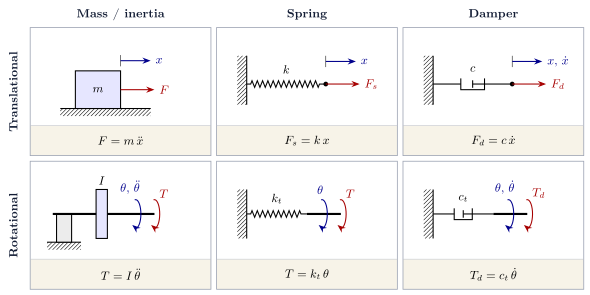
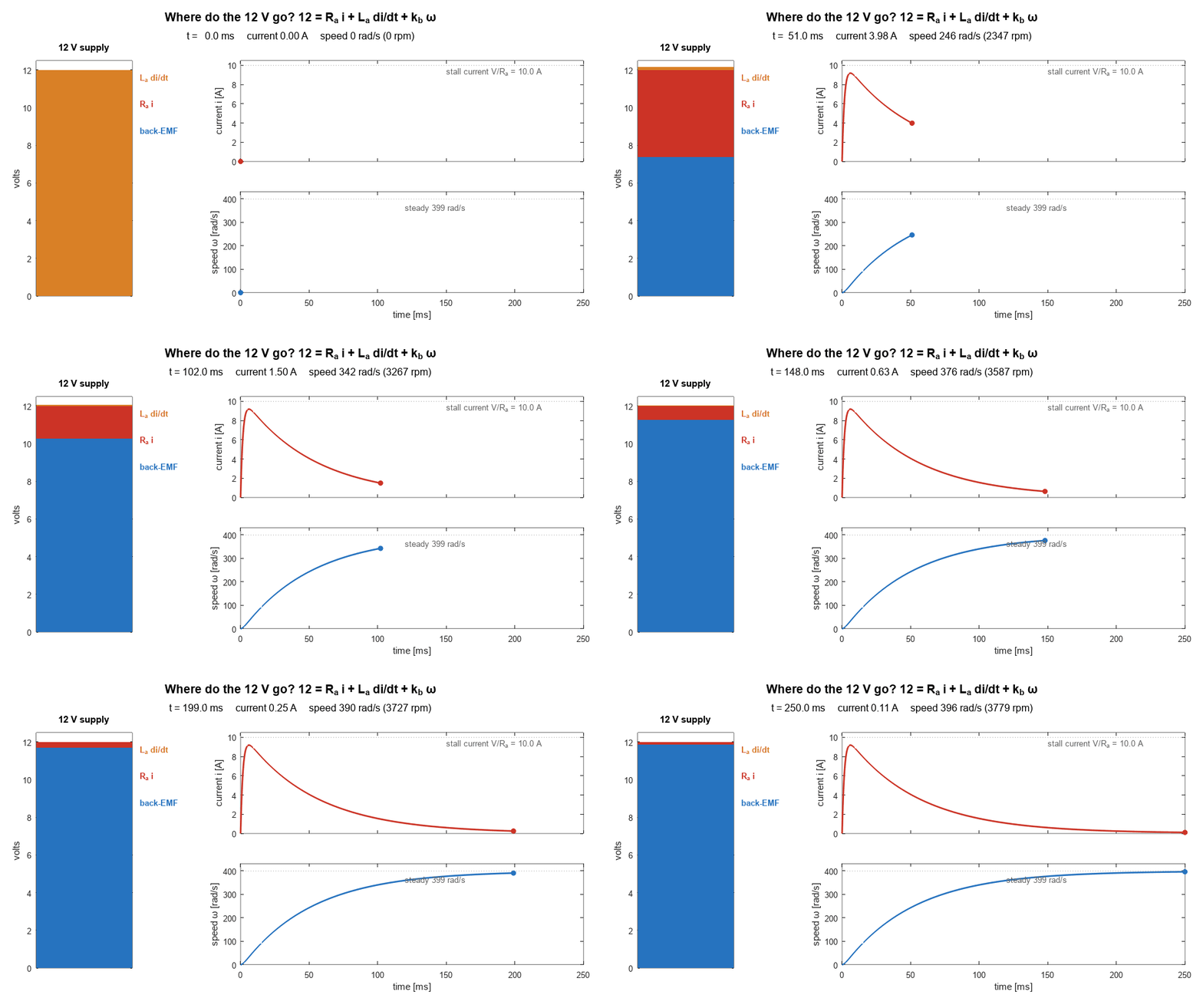
Mass, spring and damper, sliding and turning: every mechanical model is built from these. The animation follows a motor as its back-EMF rises and takes over from the resistance.
Which formula?
Read the situation first, then pick the formula. The numbers in brackets are the handbook's equation numbers.
A body that turns about a pivot
 (3.8)
Moments about the fixed pivot O.
 (3.9)
IG about the centre of mass, shifted to the pivot by d.
Energy is easier than forces
 (3.52)
L=T−V, one equation per coordinate; no internal forces needed.
A gear between motor and load
 (3.13)
Load inertia seen at the motor side; n is the gear ratio.
A circuit
 (3.67)
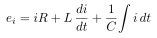
Kirchhoff's voltage law round the loop.
 (3.72)
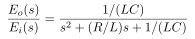
The series RLC, output across the capacitor, in monic form.
A tank
 (3.84)
Rate of storage equals inflow minus outflow.
 (3.87)
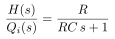
Outflow through a valve, qo=h/R: a first-order lag.
A DC motor
 (3.99)
Armature control; the back-EMF kb closes a loop inside the motor.
Reading the pictures
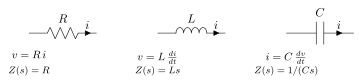
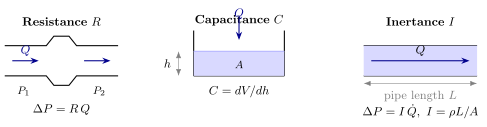
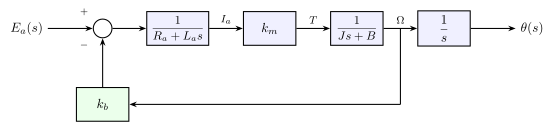
Ways to lose marks
- Signs on the free-body diagram. Assume one direction for every motion. Spring and damper forces oppose the stretch, and act equal and opposite on the two bodies they join.
- Reflected inertia. An inertia seen through a gear divides by the ratio squared, not by the ratio.
- Gravity in the equation. Measured from static equilibrium, the weight cancels the spring's pre-stretch and drops out.
- The back-EMF. It opposes the supply, so it subtracts in the armature loop.
- Tank outflow. The outflow depends on the level, so a tank is a lag, not an integrator, once a valve drains it.
Handbook: § 3.0–§ 3.8 for the worked examples and tutorials. Slides: the Chapter 3 deck, with every animation. Download the one-page PDF to print.