Chapter 4 cheat sheet
Chapter 4 cheat sheet: System performance analysis
A model says how a machine moves; a specification says how it should. This chapter reads time constants, overshoot, settling time and steady error off a transfer function, decides with Routh whether a loop is stable, and shows how the poles move as the gain is turned up.
Start here
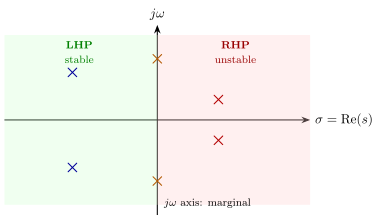
Find the poles first. A single real pole behaves like a first-order lag; a complex pair gives ζ and ωn, and from them the specifications. Check stability before any specification means anything.
One picture
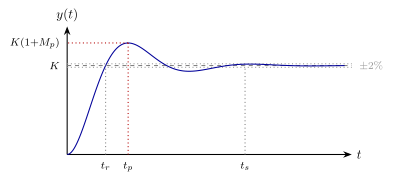
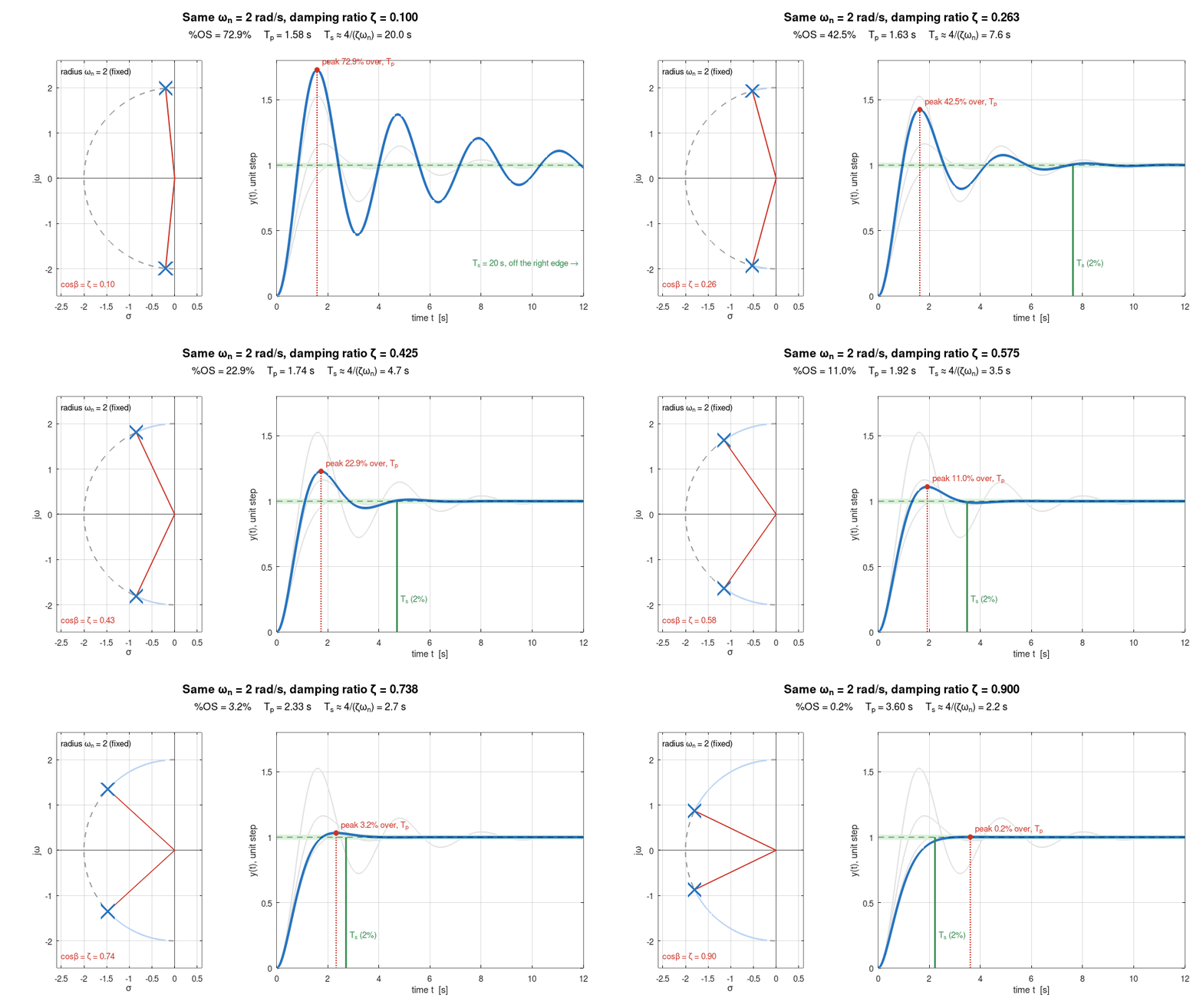
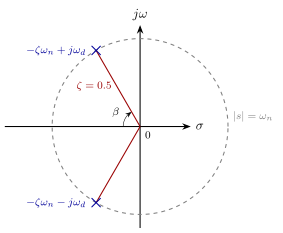
The step response of a second-order system and the numbers that describe it. The animation swings the poles round a circle of fixed ωn as ζ rises, and the overshoot and settling time follow.
Which formula?
Read the situation first, then pick the formula. The numbers in brackets are the handbook's equation numbers.
One time constant
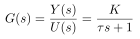 (4.2)
τ is the time to 63.2 % of the final value.
 (4.3)
The unit-step response.
A second-order plant
 (4.6)
Standard form: read ζ and ωn off the denominator.
 (4.7)
Complex for ζ<1, real and repeated at ζ=1.
How much it overshoots
 §4.2
Depends on ζ alone.
How long until it settles
 §4.2
The 2 % band; set by the real part of the poles.
The error left at the end
 (4.10)
Unity feedback, stable loop; the system type decides which inputs it tracks.
Is the loop stable?
 (4.12)
Routh array: each sign change in the first column is one right-half-plane pole.
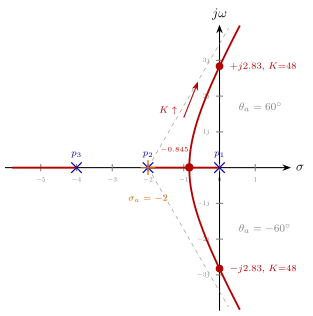
Where the poles go as K grows
 (4.17)
Asymptote angles, for n−m branches going to infinity.
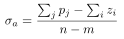 (4.18)
Where the asymptotes meet the real axis.
Reading the pictures
Ways to lose marks
- Specifications need stability. A step-response specification means nothing for an unstable loop: check every pole first.
- Two different knobs. Overshoot depends on ζ only; settling time on ζωn.
- A zero in the Routh column. Replace it by a small ε, or use the auxiliary polynomial for a whole row of zeros.
- System type. Count the integrators in the open loop G(s), not in the closed loop.
- Asymptotes. They need n−m: open-loop poles minus open-loop zeros.
Handbook: § 4.0–§ 4.6 for the worked examples and tutorials. Slides: the Chapter 4 deck, with every animation. Download the one-page PDF to print.