Chapter 1 cheat sheet
Chapter 1 cheat sheet: Control systems and the Laplace transform
A control system measures what a machine is doing, compares it with what it should be doing, and corrects the difference. This chapter gives the language: the Laplace transform turns the machine's differential equations into algebra, and the transfer function holds the whole machine in one fraction.
Start here
Decide first whether the loop is open or closed: does the controller see the output? Then transform with zero initial conditions, write G(s)=Y(s)/U(s), and find its poles: they say how it moves.
One picture
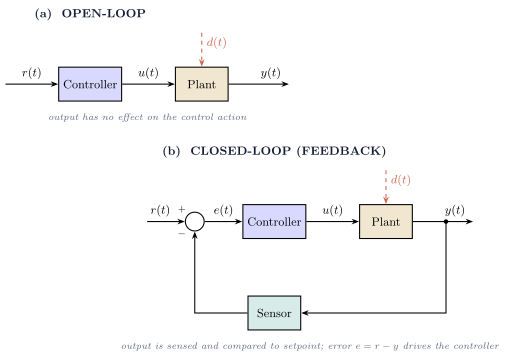
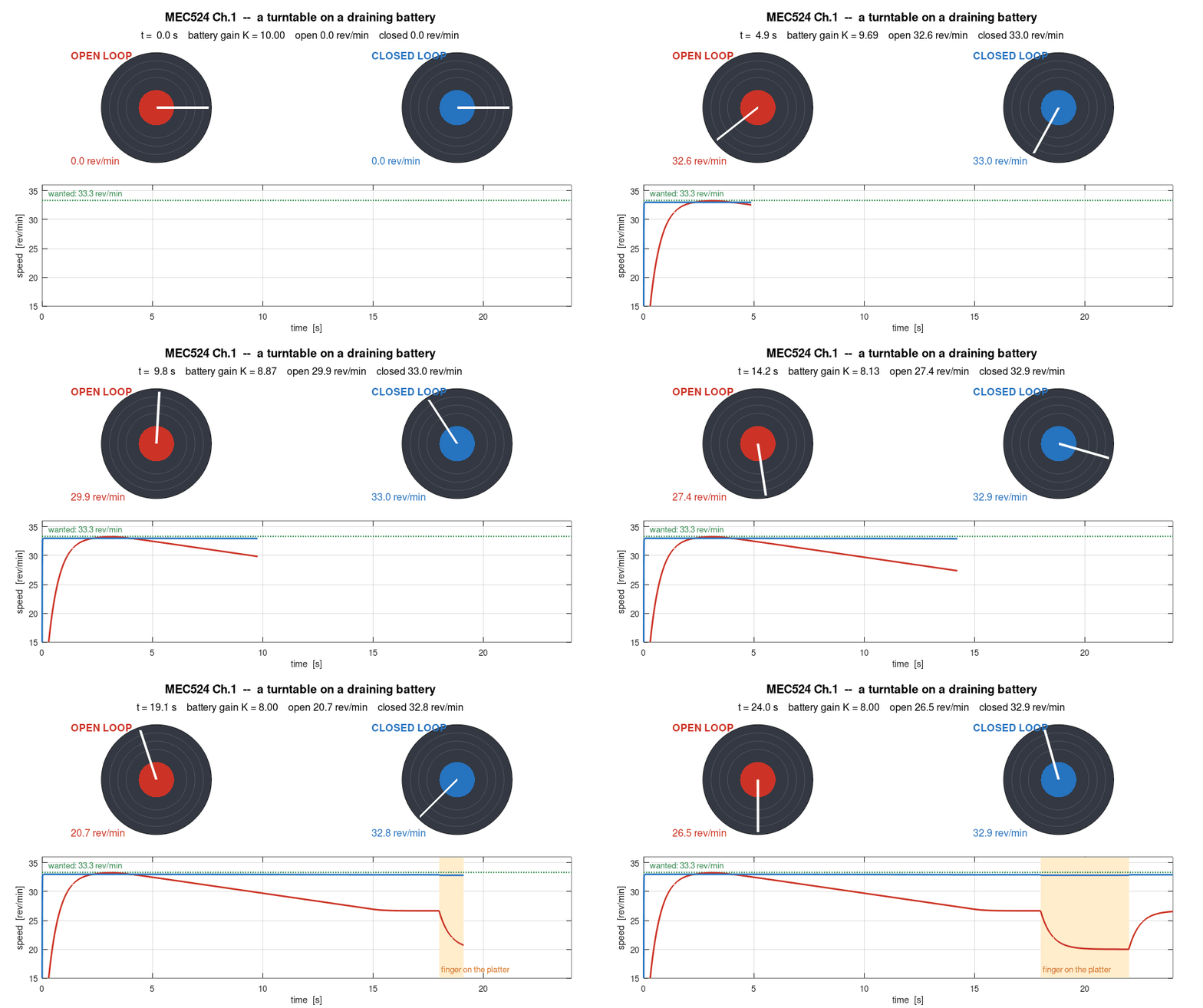
Open loop acts on a plan and never sees the result; closed loop measures the output and corrects the error. The animation drains the battery of a turntable and presses a finger on the platter: the closed loop holds its speed far better.
Which formula?
Read the situation first, then pick the formula. The numbers in brackets are the handbook's equation numbers.
A differential equation to solve
 (1.3)
Each derivative brings its initial conditions with it; they are zero for a transfer function.
A fraction to turn back into time
 (1.7)
Factor the denominator first: distinct, repeated and complex roots each take their own partial-fraction form.
How the machine turns input into output
 (1.12)
Zero initial conditions. The degree of the denominator is the order.
Where it is fast, slow or unstable
 (1.13)
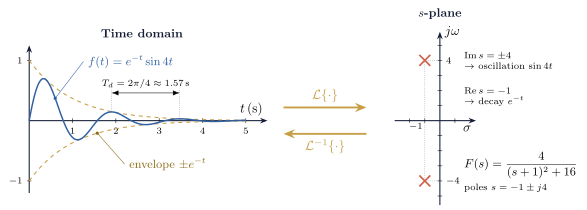
The poles, the roots of the denominator, set how it moves; the zeros only change the mix.
A sensor feeding the output back
 (1.14)
Negative feedback through the sensor H(s); unity feedback has H=1.
Choosing a controller
 (1.15)
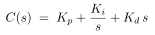
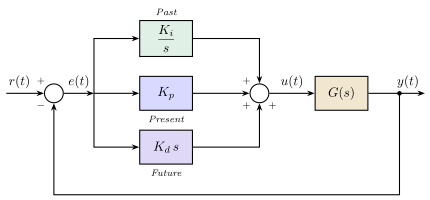
P acts on the error now, I on its history, D on its trend.
Reading the pictures
Ways to lose marks
- Initial conditions. A transfer function assumes the system starts at rest. A response from a non-zero start needs the derivative rule in full.
- Open loop cannot correct. It never sees the output, so a disturbance or a drifting part goes uncorrected.
- The feedback sign. Negative feedback puts 1+GH in the denominator. A minus sign there is positive feedback.
- Poles decide stability. Every pole in the left half-plane means stable; the zeros play no part in stability.
- Steady error. Proportional action alone leaves an offset for a step; the integral term is what removes it.
Handbook: § 1.0–§ 1.6 for the worked examples and tutorials. Slides: the Chapter 1 deck, with every animation. Download the one-page PDF to print.